

In an unexpected twist in the immigration debate, President Donald Trump announced the creation of the Gold Card, a proposal that seeks to attract foreign investors through a direct payment of $5 million dollars to the U.S. government. The initiative promises to revolutionize the immigration system, generating millions of dollars in revenue for the country and offering privileged access to permanent residency.
The proposal has generated intense debate: is this an innovative solution to strengthen the U.S. economy or a way to sell residency to the wealthiest? What impact will it have on the current investor visa program? In this article, we explore all the details, implications, and alternatives.
What is the Gold Card?
The Gold Card is an initiative announced by former President Donald Trump on February 25, 2025 that would allow foreigners to obtain permanent residency in the United States in exchange for a payment of $5 million to the government.
Commerce Secretary Howard Lutnick noted that this program could replace the current EB-5 in two weeks. Unlike EB-5, which requires investments in job-creating projects, this new visa would involve a direct injection of capital with no apparent additional conditions.
Trump has justified the move by saying it could generate massive revenue without hurting the U.S. taxpayer.
How to Get a Gold Card in 2025
While the full details have not yet been revealed, the main requirements to obtain the Gold Card in 2025 are anticipated to be:
1. Minimum millionaire investment:
As mentioned above, applicants will need to make a one-time payment of $5 million to the U.S. government. This direct financial contribution is designed to replace the current EB-5 program, which calls for investments in specific projects that generate at least 10 jobs. Unlike EB-5, the Gold Card will not require funds to be allocated to particular projects, but will focus on a direct injection of capital into the public purse.
2. Background Check:
To ensure the integrity of the program and national security, applicants will undergo a rigorous background check process. This process aims to ensure that the funds invested come from legal sources and that applicants are “high-level” individuals and “exemplary global citizens.” Commerce Secretary Howard Lutnick emphasized that strict measures will be implemented to assess the source of funds and the reputation of investors.
3. Eligibility:
The program will be open to citizens of any nationality, with no restrictions based on country of origin. This includes individuals from diverse backgrounds, as long as they meet the established financial and verification requirements.
Official sources have anticipated that the implementation and supervision of the Gold Card will be in charge of a new federal office specialized in visas for high-net-worth investors. This entity will be responsible for processing applications, carrying out the necessary verifications and ensuring compliance with the established criteria. The aim is to create an efficient administrative structure that facilitates the process for applicants and ensures the transparency and effectiveness of the programme.
What benefits will the Gold Card grant in the United States?
The Gold Card would offer multiple advantages to eligible investors. One of the most prominent benefits is immediate permanent residency, since applicants will receive the Green Card without the long wait times of other immigration programs.
Another key point is freedom of movement, since Gold Card holders will be able to live, work and study in any state of the country without restrictions. This flexibility will allow them to choose the best location according to their personal or professional interests, facilitating access to strategic job markets, prestigious educational centers and communities that fit their lifestyle.
The program also promises a fast path to citizenship compared to EB-5, which requires a minimum of five years of residency before applying for naturalization. Although specific timelines have not yet been specified, Gold Card holders are expected to have more expeditious access to the citizenship process, removing some of the administrative barriers that often slow down the transition to naturalization.
Finally, family inclusion is a fundamental component of the Gold Card, as the benefit is extended to spouses and children under the age of 21 at no additional cost. This ensures that families can move in together and access the same rights in terms of residence, education, and employment, allowing them to comprehensively adapt to the new environment without additional financial worries.
Trump-Driven Gold Card Controversies
To better understand the impact of this initiative, it is key to compare the golden visa with the EB-5 visa, the current investor program:
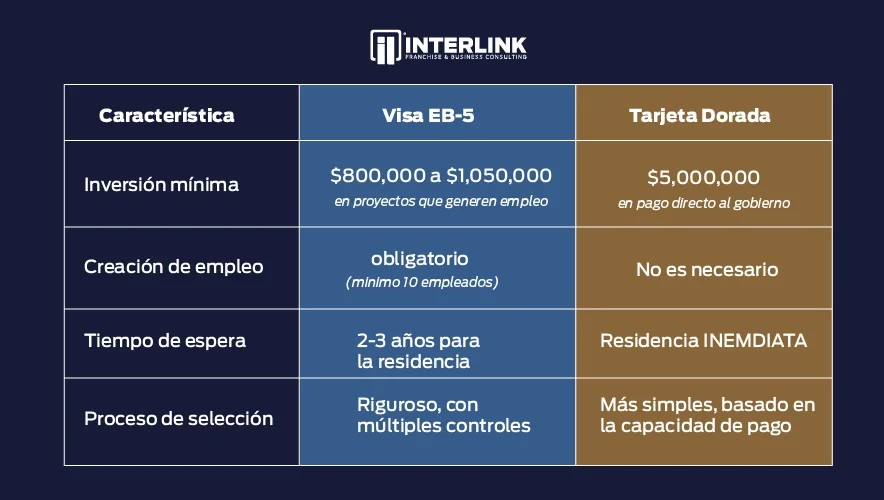
The implementation of the Gold Card has generated an intense debate among immigration experts, economists and politicians. While some see it as an agile alternative to attract high-net-worth investors, others warn about its risks and legal implications.
On the one hand, proponents of the program highlight that it could strengthen the economy by attracting direct resources to the government without relying on private investments or third-party real estate projects, as in the case of the EB-5 visa. In addition, by eliminating the obligation to generate employment, it simplifies the process and significantly reduces waiting times for applicants. Economists have pointed out that similar schemes have worked in countries such as Portugal and the United Arab Emirates, attracting foreign capital without negative impact on taxpayers.
Beyond these benefits, critics of the new Trump-driven program warn of several risks:
1. Lack of control over the origin of funds:
Unlike EB-5, which requires rigorous audits and certifications, the Gold Card could be more vulnerable to money laundering operations.
2. Exclusivity and inequality:
As it does not require investment in the local economy or job creation, it is perceived as a shortcut for the richest, with no tangible benefits for the population in terms of economic development.
3. Impact on migration policy:
It could put pressure on the permanent residency system, displacing applicants from other categories who face long waits.
In addition, immigration experts have questioned the legality of the measure. Jessica Vargas, an immigration attorney in Miami, warned, “There is no precedent for such a straightforward program. EB-5 at least requires job creation, while this proposal seems to reduce migration to a simple financial transaction.” They also noted that any changes to the visa system require congressional approval, which could pose an obstacle to implementation.
While the EB-5 visa seeks to balance the benefit to the investor with the impact on the economy and employment, the Gold Card prioritizes the speed and simplicity of the process in exchange for a direct financial contribution. This raises the underlying question: which model is most effective in promoting development without compromising the integrity of the immigration system? The answer is: it depends.
E-2 Visa: A Safe and Accessible Relocation Alternative
Although the Gold Card promises a fast track to residency in the United States, its high cost and doubts about its legal viability make many investors look for safer and more accessible alternatives.
There are already established investor visas that allow businessmen and entrepreneurs to obtain immigration status in the U.S. without facing regulatory uncertainties.
For investors who want to live and operate a business in the United States without shelling out $5 million, the E-2 visa is a viable and proven alternative. This visa allows citizens of countries with trade treaties with the U.S. to obtain a renewable visa in exchange for a smaller investment, usually as low as $150,000, in a U.S. business.
Some advantages of the E-2 visa:
Accessible investment: Flexible amount depending on the business. There is no set minimum amount, but an investment of at least $150,000 USD is recommended to increase the odds of approval. The capital must be proportionate to the business and demonstrate a real commitment to the company.
Business control and management: The investor can actively own, direct, and operate their company in the United States, maintaining full control over business and strategic decisions.
Indefinite renewal: The E-2 visa is renewable indefinitely for periods of 2 to 5 years, as long as the business is still in operation, profitable, and generates employment or economic benefits in the country.
Benefits for the family: The investor’s spouse obtains an unrestricted work permit, allowing them to be employed in any sector or start their own business. In addition, children under 21 years of age can live and study in the United States, accessing quality and prestigious public or private education.
Agile approval process: Compared to other investment visas, the E-2 has a faster and less bureaucratic application process, allowing investors to establish themselves and operate their business in less time.
Possibility of expansion and growth: Once in the U.S., investors can expand their business, hire employees, and diversify their investment.
Although the E-2 visa does not grant permanent residency directly, it can be a strategic bridge to other immigration options.
At Interlink FBC, we have guided numerous investors in their immigration process with the E-2 visa. We have connected them with profitable franchises that allow them to meet immigration requirements while building a successful business.
Would you like to know which is the best franchise for your case? Schedule a free initial consultation with our team to find out.


